Mental health aspects of obesity
Article 04
Sponsored by

Sponsored by
Mental health aspects of obesity
Article 04
In this article, part of Economist Impact’s Science of Obesity series, we explore the mental health consequences of obesity which are associated with health implications and impaired quality of life, including the effects of weight stigma on wellbeing. All of the articles in this series address the myths around obesity, stressing that it is the underlying interplay of the socioeconomic environment alongside our genes and biology—rather than poor self-discipline— that drives obesity. A whole-of-society approach is needed to reverse this complex public health concern, with a focus on upstream drivers such as the societal and policy environment, and not just the downstream, individual effects.
How do obesity and mental health interact?
Obesity rates have risen dramatically across the globe over the past 40 years; by 2035 it is estimated that half of the world’s population will live with overweight or obesity.1 Obesity is a global challenge affecting every country and all socioeconomic groups. Obesity is also recognised for its complex bidirectional relationship with mental health, which impacts quality of life. As stated in other articles in this series, the rising prevalence of this multifactorial disease is not down to one factor such as an individual’s lack of willpower. Overweight and obesity are associated with changes in our socioeconomic and food environment, such as the proliferation of affordable, calorie-dense food, coupled with biological mechanisms that favour weight gain.2
Mental health and obesity are linked in a complex bidirectional relationship.3 Figure 1 shows how they interact.
People living with obesity are 32% more likely to develop depression.4 Having obesity also increases the risk of developing an anxiety disorder by 30% and this risk further escalates for people with severe obesity.5 There is also some evidence that women are at further increased risk compared to men.3
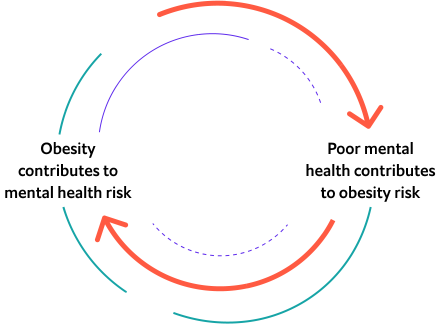
Figure 1: Bi-directional relationship between obesity and mental health
This increased mental health risk among people with obesity may be due to stigma, discrimination, low self-esteem and dealing with physical conditions associated with obesity such as osteoarthritis and diabetes. Systemic inflammation and hormonal disruptions caused by obesity have also been implicated in contributing to poorer mental health.6 Furthermore, young people living with obesity are at an increased risk of suicide. For example, a US study showed that obesity is linked to suicide ideation and planning in adolescents, even after adjusting for psychosocial factors.7
In turn, people living with mental health conditions are more likely to develop obesity.3 Factors involved may include side effects from medication, inability to engage in physical activity, social withdrawal and comfort eating.3
Children and adolescents are profoundly impacted by living with obesity
Children and adolescents living with obesity are around twice as likely to have major depressive disorder compared to healthy controls.8 Another study found that the risk of depression is higher among girls living with obesity compared to peers without obesity; this increased risk of depression continues into adulthood.9 Children and adolescents living with obesity have lower psychological wellbeing scores and are more likely to experience difficulties in peer relationships and behavioural struggles.10
Exposure to obesity in the womb can also increase children’s risk of developing mental health conditions. Maternal obesity increases the risk by 39% and paternal obesity increases the risk by 17%; although we do not necessarily understand exactly how or why this is happening, it is further impetus for action on obesity.11 Table 1 highlights the increased risk of some mental health conditions among the children of women with obesity.11


Table 1: Increased risk of mental health conditions in children of mothers living with obesity11
Note: These data were mainly based on studies from US and Europe.
Obesity therefore not only affects individuals’ mental and physical health across their own lifetime, but also appears to have an intergenerational impact. It affects the next generation through biological mechanisms, and through social determinants of health such as poor housing and poor access to healthy foods.
“A lot of obesity comes back to the usual social determinants of health. It’s income, it’s security, it’s locus of control, it’s education.”
Professor Arya Sharma, Founder of Obesity Canada

Stigma associated with obesity is prevalent
Weight stigma is the negative attitudes and stereotypes about people who live with obesity.12 It is usually a consequence of the common misconception that a person’s weight is completely under their control. As we have seen throughout the Science of Obesity series, obesity is due to a combination of factors including genetic predisposition, physiological processes and living in an obesogenic environment (that is, an environment that makes it difficult for individuals to maintain a healthy weight).
The consequences of weight stigma are global, wide-ranging and affect people right through the life course. Weight bias manifests in many ways, including through teasing and bullying, discrimination, and social exclusion.13 Children with obesity are more likely to have mental health problems, be absent from school and achieve lower grades.9, 14 In the workplace, weight stigma affects people’s employment, income and promotion opportunities, with women particularly affected.15, 16
On an individual level, weight stigma is associated with weight gain.13 It can exclude people from sport and exercise settings and lead people to avoid seeking medical help, and it is also associated with binge-eating, sedentary behaviour, anxiety, depression, lower self-esteem, stress, social isolation, healthcare disparities, substance misuse and increased risk of mortality.13, 17-20
“We know that individuals with obesity are less likely to be hired at the same salary as someone who doesn’t have the disease. We think that’s probably one of these almost mindless biases.”
Dr David Sarwer, Director for Obesity Research and Education, Temple University
An analysis of over 59,000 participants found a strong association between weight stigma and mental health.20 This was strongest for self-stigma (when an individual is aware of the negative stereotypes about people with obesity, agrees with these beliefs and applies them to themselves).20, 21 It is also estimated that around 40-50% of people living with overweight or obesity in the US experience self-stigma or “internalised weight bias ”.13 Weight stigma is associated with body image dissatisfaction, reduced quality of life, symptoms of depression, dysfunctional eating, symptoms of anxiety, psychological distress and low self-esteem.20
“What we are seeing is that those experiences of stigma and bias take an emotional toll on people as well.”
Dr David Sarwer, Director for Obesity Research and Education, Temple University

How can we tackle weight stigma?
There is a clear imperative to address the global obesity epidemic, otherwise the consequences will cripple economies and health services across the world. The current global economic cost of overweight and obesity is estimated to be around US$2tn annually; this is predicted to increase to over US$3tn by 2030 and US$18tn by 2060.22
The causes of obesity are wide-ranging and require integrated policies across all areas of governments, including health, agriculture, transport, urban planning, environment, food processing, distribution, marketing and education.23 We explore these in more detail in our article on Social determinants of health and obesity. In highlighting the importance of tackling obesity, it is imperative that messages do not perpetuate or increase weight stigma. Tackling weight stigma contributes to reducing the psychological distress of people living with obesity, but it is also an important aspect of how we address obesity as a societal issue.
Education and portrayal are two interconnected activities that could help to address weight stigma (see Figure 2).24 Education is needed for populations and health professionals to better inform them about the causes of obesity and how we can manage it. People must better understand the underlying mechanisms of obesity, its multifactorial causes and, therefore, why tackling it is not as simple as an individual just having more willpower. The portrayal of obesity and people living with obesity in the media, in government policy and elsewhere is important as an avenue to change perceptions and reinforce education efforts. This means fairly portraying people living with obesity, not reverting to inaccurate stereotypes or deliberately shocking images, and using people-first language rather than condition-first language, where people are defined by their disease.25
"When you think about societal impacts, there’s all the lost productivity that comes from people being sick and not being able to work. There’s also the negative impact of weight stigma which is associated with depression, substance abuse and delays seeking care."
Dr Sara Bleich, Professor of Public Health Policy, Harvard University
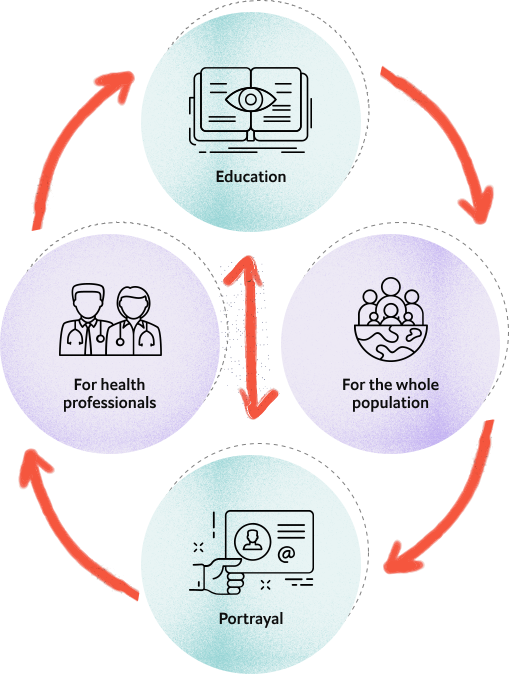
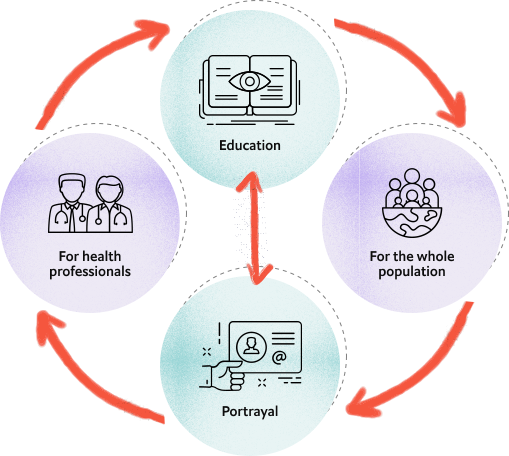
Figure 2: Key approaches for tackling weight stigma
Source: Economist Impact analysis

Action needed to improve mental health and obesity
Individual-level interventions do not work for the majority of people, as the prevention and treatment of obesity is complex and requires lifelong lifestyle changes. Yet most people do not know this. Addressing this misconception by increasing awareness of the science underlying obesity will help to address stigma and contribute to better, more effective policy-making.
- Weight bias and stigma should not be tolerated. There is a strong imperative to address the vicious circle of obesity and mental health issues. However, with adequate and sustained multi-disciplinary professional help, people living with obesity can be supported to maintain a physically and mentally healthy life. Our societies need to refrain from using stigmatising language and encourage educational initiatives aimed at removing stigma.
- Sustained and sustainable interventions are needed. Mental health and wellbeing is an essential aspect of obesity management. However, there are not enough resources to give people sufficient support throughout their lifetime. Stigma should be tackled in schools, the workplace and in healthcare environments, starting with the use of people-first language. Tackle the social and environmental factors at play to support obesity management and prevention efforts. Considering the complex nature of obesity, we need a change in the environment we live in so that it no longer encourages weight gain. A strong and radical response across all of government and society—that includes evidence-based and effective regulatory measures—is required.
“This is not about willpower. This is not about intelligence. This is about a physiological process which is worsening against the pressures of the environment around us.”
Dr David Sarwer, Director for Obesity Research and Education, Temple University
“To address rising obesity rates, it requires a lot of buy-in, not just from governments, but other sectors, and that sort of coordinated action has not happened effectively.
Dr Sara Bleich, Professor of Public Health Policy, Harvard University
The editorial team at Economist Impact would like to thank the following individuals for generously contributing their time and insights pro bono: Professor Steven Allender, Dr Sara Bleich, Ms Tiffany Petre, Dr David Sarwer, Professor Arya Sharma, Dr Uku Vainik.
References
1 World Obesity Federation. World Obesity Atlas 2023 [Internet]. World Obesity Federation. Available from: https://data.worldobesity.org/publications/?cat=19.
2 Lee A, Cardel M, Donahoo W. Social and Environmental Factors Influencing Obesity. In: Feingold KR, Anawalt B, Blackman MR, et al., editors. Endotext. South Dartmouth (MA): MDText.com, Inc.
Copyright © 2000-2024, MDText.com, Inc.; 2000.
3 Rajan TM, Menon V. Psychiatric disorders and obesity: A review of association studies. J Postgrad Med. 2017;63(3):182-90.
4 Westbury S, Oyebode O, van Rens T, et al. Obesity stigma: causes, consequences, and potential solutions. Current Obesity Reports. 2023;12(1):10-23.
5 Fulton S, Décarie-Spain L, Fioramonti X, et al. The menace of obesity to depression and anxiety prevalence. Trends Endocrinol Metab. 2022;33(1):18-35.
6 Steptoe A, Frank P. Obesity and psychological distress. Philos Trans R Soc Lond B Biol Sci. 2023;378(1888):20220225.
7 Iwatate E, Atem F, Jones E, et al. Association of Obesity, Suicide Behaviors, and Psychosocial Wellness Among Adolescents in the United States. J Adolesc Health. 2023;72(4):526-34.
8 Rao W, Zong Q, Zhang J, et al. Obesity increases the risk of depression in children and adolescents: Results from a systematic review and meta-analysis. J Affect Disord. 2020;267:78-85.
9 Sutaria S, Devakumar D, Yasuda SS, et al. Is obesity associated with depression in children? Systematic review and meta-analysis. Arch Dis Child. 2019;104(1):64-74.
10 Förster L, Vogel M, Stein R, et al. Mental health in children and adolescents with overweight or obesity. BMC Public Health. 2023;23(1):135.
11 Zhang S, Lin T, Zhang Y, et al. Effects of parental overweight and obesity on offspring's mental health: A meta-analysis of observational studies. PLoS One. 2022;17(12):e0276469.
12 Papadopoulos S, Brennan L. Correlates of weight stigma in adults with overweight and obesity: A systematic literature review. Obesity. 2015;23(9):1743-60.
13 Rubino F, Puhl RM, Cummings DE, et al. Joint international consensus statement for ending stigma of obesity. Nat Med. 2020;26(4):485-97.
14 World Obesity Federation. World Obesity Atlas 2022 [Internet]. World Obesity Federation. Available from: https://data.worldobesity.org/publications/?cat=15.
15 Sánchez-Carracedo D. Obesity stigma and its impact on health: A narrative review. Endocrinol Diabetes Nutr (Engl Ed). 2022;69(10):868-77.
16 Giel K, Thiel A, Teufel M, et al. Weight bias in work settings - a qualitative review. Obes Facts. 2010;3(1):33-40.
17 Thedinga H, Zehl R, Thiel A. Weight stigma experiences and self-exclusion from sport and exercise settings among people with obesity. BMC Public Health. 2021;21(1):565.
18 Sutin A, Stephan Y, Terracciano A. Weight Discrimination and Risk of Mortality. Psychol Sci. 2015;26(11):1803-11.
19 Phelan S, Burgess D, Yeazel M, et al. Impact of weight bias and stigma on quality of care and outcomes for patients with obesity. Obes Rev. 2015;16(4):319-26.
20 Emmer C, Bosnjak M, Mata J. The association between weight stigma and mental health: A meta-analysis. Obes Rev. 2020;21(1):e12935.
21 Pearl R, Puhl R. Weight bias internalization and health: a systematic review. Obes Rev. 2018;19(8):1141-63.
22 World Obesity Federation. The Economic Impact of Overweight & Obesity in 2020 and 2060 [Internet]. World Obesity Federation. Available from: https://data.worldobesity.org/publications/WOF-Economic-Impacts-2-V2.pdf.
23 WHO. Obesity and overweight [Internet]. World Health Organization. Available from: https://www.who.int/news-room/fact-sheets/detail/obesity-and-overweight.
24 World Obesity Federation. Weight Stigma [Internet]. World Obesity Federation. Available from: https://www.worldobesity.org/what-we-do/our-policy-priorities/weight-stigma.
25 EASO. People-first language [Internet]. European Association for the Study of Obesity. Available from: https://cdn.easo.org/wp-content/uploads/2018/12/16195533/EASO-People-first-Language_Version-5-CMYK-for-print.pdf.
Share your thoughts on social media

Lorem ipsum dolor sit amet, consectetur adipiscing elit
Lorem ipsum dolor sit amet, consectetur adipiscing elit lorem ipsum dolor sit amet, consectetur adipiscing elit, sed do eiusmod tempor incididunt ut labore et dolore magna aliqua.
Explore more articles
Article 02
Obesity: the role of genetics, biology and physiology
Our body's regulation of food intake is complex and very little of it is within our conscious control.
Article 01
What is obesity and why does it matter?
By 2035, around half of the world's population will be living with overweight or obesity, so a whole-of-government response is needed.
Article 03
Social determinants of health and obesity
Social determinants of health, including food marketing, built environment, education and income, contribute to the development of obesity.