What is obesity and why does it matter?
Article 01
Sponsored by

Sponsored by
What is obesity and why does it matter?
Article 01
Despite the scientific evidence that demonstrates otherwise, obesity is commonly misconceived as being a result of poor choices made by individuals. In this opening article of Economist Impact’s Science of Obesity series, we explore the various and interconnected web of factors that influence obesity and discuss why they matter.
What is obesity?
In 2020, nearly 1 billion people around the world were living with obesity.1 There are no signs that rates are stabilising in any country, let alone falling. The World Obesity Federation estimates that by 2035 this figure will continue to rise, with half of the world’s population living with overweight or having obesity (Figure 3).1
Can you guess the % of the world population estimated to have overweight or obesity by 2035?
Most worrying is the number of children and adolescents with obesity, as this is likely to continue into adulthood. Whereas in 1975 less than 1% of all children aged 5-19 were affected by obesity, that figure is now 8-10% and is predicted to rise to 18-20% by 2035.1, 2 Obesity levels rose more quickly than predicted during the covid-19 pandemic, especially in children under five years old.3
The WHO has classified obesity as a chronic disease.4 It is now considered to be an epidemic with multiple, complex causes including inequalities and social determinants of health, and is not simply due to an individual’s lack of willpower.4

Figure 1: Estimates of obesity prevalence in adults (BMI≥30 kg/m2)5
"There is no country in the world in which obesity is not a significant problem."
Professor Arya Sharma, Founder of Obesity Canada
Why does obesity matter?
The burden of obesity for an individual is immense. Overweight and obesity account for more than 1.3m deaths globally each year and are linked to more deaths worldwide than underweight.6, 7 Obesity is directly linked to at least 38 noncommunicable diseases (NCDs) including diabetes, hypertension, cardiovascular disease, chronic kidney disease, metabolic dysfunction associated fatty liver disease, osteoarthritis, depression and 13 types of cancer.8 These conditions are often interlinked, increasing the risk of simple multimorbidity (two conditions) and complex multimorbidity (four or more conditions), with higher risks for people with more severe obesity.8 Indeed, after increasing age, obesity is the second predictor of covid-19 complications or mortality.9 Having multiple conditions reduces individuals’ quality of life and puts a strain on healthcare resources.
"In the last 30 years we’ve seen obesity rates skyrocket. We are truly facing a public health crisis.”
Dr David Sarwer, Director for Obesity Research and Education, Temple University
Childhood obesity is linked to lower self-esteem, poorer school performance, bullying and poorer health, including metabolic disorders such as type 2 diabetes.10 In 2021 around 41,600 new cases of type 2 diabetes were diagnosed in children and adolescents worldwide.11 This is particularly alarming because type 2 diabetes is preventable and leads to earlier complications when it develops in childhood.12
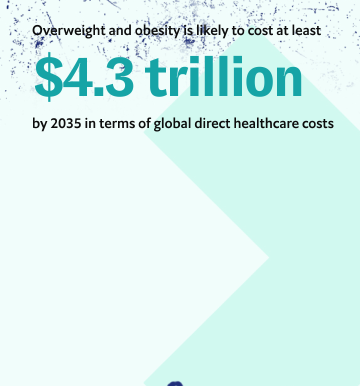
The World Obesity Federation predicts that the continuing rise in overweight and obesity is likely to cost at least US$4.3trn by 2035 in terms of global direct healthcare costs (treatment costs for obesity and associated diseases) and indirectly through lost employment, early retirement and premature death.1 There are clear individual, social and economic cases for investing in obesity prevention and management today to reduce these future costs.
Obesity definition
Obesity is defined by excessive fat that can impair health.4 It is a complex disease resulting from a combination of genetic, social, psychological and environmental factors. According to European guidelines, obesity is crudely measured using a body mass index (BMI, derived from an individual’s mass and height) greater than or equal to 30 kg/m2 in adults. Lower BMI cut-off points of 27.5 kg/ m2 apply to some ethnic groups (such as South Asian and Middle Eastern populations). In children under the age of five, obesity is weight-for-height greater than 3 standard deviations above the World Health Organisation (WHO) Child Growth Standards median.4 For children aged 5-19, it is 2 standard deviations above the WHO Growth Reference median.4
What are the misconceptions around obesity?
The traditional view that obesity is due to lack of individual responsibility needs to be dispelled, as it does not take into account the many physiological, biological, genetic, social, cultural and environmental factors that may affect someone’s risk of developing obesity. This inaccurate and simplistic view is also stigmatising, leading to discrimination.13, 14
For instance, globally our environment is becoming increasingly obesogenic—in other words, more and more it facilitates obesity.15 Advertising and marketing have influenced social and cultural norms around food and drink in many societies, including by normalising fast-food consumption and promoting the consumption of unhealthy foods. Technological and digital advances have led to more sedentary jobs and pastimes. We explore the role of these broader social determinants of health in impacting obesity in a separate article in the Science of Obesity series.
Interventions that are aimed at supporting individuals to change their diet and increase physical activity tend to follow a pattern of weight loss, plateau then progressive weight regain.15, 16 One reason for this is that hormonal changes that influence appetite regulation occur in the body as a defence mechanism, making further weight loss more difficult.15, 16 We explore the role that biology plays in influencing obesity outcomes in another article within this series. Encouraging people living with obesity to focus on making sustainable, positive changes to their diet quality and physical activity whilst seeking guidance and support from healthcare professionals can be more beneficial and motivating than focusing solely on weight loss as an indicator of “success” or “failure”.13, 15 Also, as one study puts it, “long-term benefits require long-term attention”, so people living with obesity who are making such lifestyle changes require sustained support.15 All people living with obesity also require access to obesity prevention and management services.19
“Our behaviour is so strongly influenced by these external environmental variables that are beyond our control.”
Dr David Sarwer, Director for Obesity Research and Education, Temple University
A common misconception is that reducing one’s caloric intake and becoming more active is a “one size fits all” solution for treating obesity. However, the reality of the matter is that there is substantial evidence showing that obesity is influenced by various drivers that lie outside of an individual’s control. For instance, on a biological level, the body’s innate physiological response can play a significant role in defending against weight loss. On a broader societal level, environmental factors such as a lack of access to affordable healthy food options or limited opportunity to safely and affordably engage in physical activities can influence obesity outcomes.17 Policy interventions must recognise the role of factors outside of an individual’s control if they are to effectively address obesity rates.
What has been done so far and why hasn’t it worked?
The WHO officially recognised obesity as a global epidemic in 1997.18 Efforts since then could be described as well-intended but inadequate at a national and global level. No country is on track to meet the two Sustainable Development Goals most relevant to obesity—reducing premature mortality from NCDs by a third and ending malnutrition (wasting and overweight) in children under 5 by 2030.4 Without tackling obesity, these targets will not be met.4 One explanation for why these efforts may not have worked so far is because they fail to address the key societal and cultural factors that determine food choices and activity levels, says Arya Sharma, professor of medicine at the University of Alberta, Canada.
“But what is stopping us from effectively treating obesity as a chronic disease? One is certainly cost, the other is the ideology that obesity is largely under a person’s control and only requires some will-power to overcome.”
Professor Arya Sharma, Founder of Obesity Canada
The WHO Acceleration Plan to Stop Obesity focuses on supporting 28 countries across the six WHO regions to adopt a range of evidence-based, multi-sectoral strategies.4 The idea is to share learnings, refine interventions and roll them out to other, comparable countries. However, only a handful of the proposed policy interventions have been prioritised by these countries in their obesity plans so far (Figure 2).
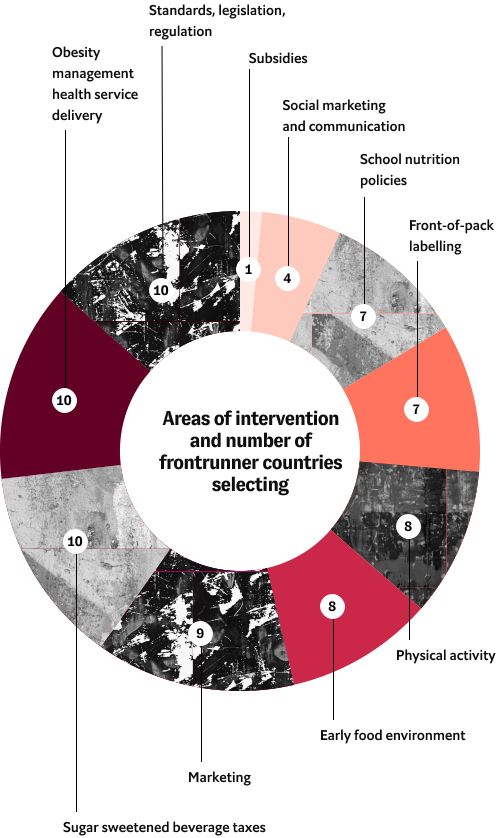
Figure 2: Number of frontrunner countries prioritising each obesity intervention category identified by the WHO4
In 2023 the WHO launched a new framework for the health system component of the Acceleration Plan to Stop Obesity that highlights the need for management of obesity as a chronic disease that requires sustainable universal health coverage for obesity management before comorbidities occur.19
To advance obesity primary prevention efforts, UNICEF advocates for an integrated, whole-systems approach based on:20
- promoting healthy diets for children and adolescents through clearer messaging and education, plus access to healthier food at school, home and in the community;
- regulating the food and beverage industry to restrict marketing unhealthy foods to children and require clear front-of-packaging labelling and sugar taxation;
- promoting physical activity in the school curriculum, as well as better urban design and transport infrastructure.
The question remains, why are interventions that are evidence-based, impactful and cost-effective not being implemented? “The solution to the obesity epidemic is political will, a plan of action and the resources and commitment to deliver,” says the WHO. However, the poor uptake of evidence-based policy interventions suggests that further action is needed, even in countries considered global frontrunners in addressing obesity.4
“This is not an area where there is one single thing that will solve it. It is an area where a whole set of approaches need to happen in concert.”
Dr Sara Bleich, Professor of Public Health Policy, Harvard University
What do we need to do next?
“There’s often not the political will to implement evidence-based policies that are going to make a difference.”
Dr Sara Bleich, Professor of Public Health Policy, Harvard University
Obesity-related policy would support progress towards 13 out of the 17 Sustainable Development Goals, including those relating to health, climate change, sustainability, equality and poverty.21 However, progress towards advancing obesity prevention and management will require strong and sustained political commitment.
- No single sector or actor alone can address the obesity challenge. In order to halt rising obesity rates globally, obesity management and prevention cannot continue to be the sole responsibility of health ministries. Rather, a coordinated approach involving multi-sectoral engagement and action will be necessary to achieve meaningful reductions in obesity rates.
- The impacts of obesity are felt by society at large, so we all share a joint responsibility to tackle this issue. The downstream societal impacts of tackling the obesity epidemic cannot be understated. Reimagining obesity-related policy interventions as an investment to reduce the predicted US$4.3trn costs of obesity, rather than seeing them as a cost today, would also help to achieve necessary political buy-in and long-term, sustained commitment.1, 4, 21
- There is a pressing need to correct the pervasive misconception that obesity is a matter of individual responsibility. Doing so would enable us to address obesity in a way that is effective and sustainable for individuals, societies and the planet. There is no quick or easy answer, but the world cannot afford not to act through a combination of policy, education and healthcare improvements.
- Given the complex drivers of obesity and its broad impacts, it is clear that prioritising a whole-of-government and whole-of-society response will be needed to reverse rising obesity rates because obesity impacts the whole of society.
“We have exhausted personal responsibility. We need to change the global food environment.”
Dr Uku Vainik, Associate Professor, Institute of Genomics, University of Tartu
The editorial team at Economist Impact would like to thank the following individuals for generously contributing their time and insights pro bono: Professor Steven Allender, Dr Sara Bleich, Ms Tiffany Petre, Dr David Sarwer, Professor Arya Sharma, Dr Uku Vainik.
References
1 World Obesity Federation. World Obesity Atlas 2023 [Internet]. World Obesity Federation. Available from: https://data.worldobesity.org/publications/?cat=19.
2 World Obesity Federation. Prevalence of obesity [Internet]. World Obesity Federation. Available from: https://www.worldobesity.org/about/about-obesity/prevalence-of-obesity.
3 Ling J, Chen S, Zahry N, et al. Economic burden of childhood overweight and obesity: A systematic review and meta-analysis. Obesity Reviews. 2023;24(2):e13535.
4 WHO. WHO acceleration plan to stop obesity [Internet]. World Health Organization. Available from: https://iris.who.int/bitstream/handle/10665/370281/9789240075634-eng.pdf?sequence=1.
5 Global Obesity Observatory. Presentation maps: Estimates for prevalence of obesity in adults [Internet]. Global Obesity Observatory. Available from: https://data.worldobesity.org/maps/?area=maps.
6 WHO. Obesity and overweight [Internet]. World Health Organization. Available from: https://www.who.int/news-room/fact-sheets/detail/obesity-and-overweight.
7 WHO. Obesity causes cancer and is major determinant of disability and death, warns new WHO report [Internet]. World Health Organization. Available from: https://www.who.int/europe/news/item/03-05-2022-obesity-causes-cancer-and-is-major-determinant-of-disability-and-death--warns-new-who-report#:~:text=Overweight%20and%20obesity%20rank%20fourth,presents%20a%20risk%20to%20health.
8 Lam B, Lim A, Chan S, et al. The impact of obesity: a narrative review. Singapore Med J. 2023;64(3):163-71.
9 World Obesity Federation. World Obesity Atlas 2022 [Internet]. World Obesity Federation. Available from: https://data.worldobesity.org/publications/?cat=15.
10 World Obesity Federation. Childhood obesity [Internet]. World Obesity Federation. Available from: https://www.worldobesity.org/what-we-do/our-policy-priorities/childhood-obesity.
11 Wu H, Patterson C, Zhang X, et al. Worldwide estimates of incidence of type 2 diabetes in children and adolescents in 2021. Diabetes Res Clin Pract 2022;185:109785.
12 Perng W, Conway R, Mayer-Davis E, et al. Youth-onset Type 2 Diabetes: The epidemiology of an awakening epidemic. Diabetes Care. 2023;46(3):490-9.
13 Nutter S, Eggerichs L, Nagpal T, et al. Changing the global obesity narrative to recognize and reduce weight stigma: A position statement from the World Obesity Federation. Obes Rev. 2023:e13642.
14 Westbury S, Oyebode O, van Rens T, et al. Obesity stigma: causes, consequences, and potential solutions. Curr Obes Rep. 2023;12(1):10-23.
15 Hall K, Kahan S. Maintenance of lost weight and long-term management of obesity. Med Clin North Am. 2018;102(1):183-97.
16 Bray G, Kim K, Wilding J. Obesity: a chronic relapsing progressive disease process. A position statement of the World Obesity Federation. Obes Rev. 2017;18(7):715-23.
17 PCNA. Social determinants of health and obesity. Preventive Cardiovascular Nurses Association (PCNA), 2022. Available from: https://pcna.net/social-determinants-of-health-and-obesity/.
18 Jaacks LM, Di Cesare M. The Epidemiology and Social Determinants of Obesity. Clinical Obesity in Adults and Children: Wiley; 2022. p. 17-30.
19 WHO. Health service delivery framework for prevention and management of obesity [Internet]. World Health Organization. Available from: https://iris.who.int/bitstream/handle/10665/367784/9789240073234-eng.pdf?sequence=1.
20 UNICEF. Prevention of overweight and obesity in children and adolescents [Internet]. United Nations International Children's Emergency Fund (UNICEF). Available from: https://www.unicef.org/media/92331/file/Advocacy-Guidance-Overweight-Prevention.pdf.
21 World Obesity Federation. Obesity and the SDGs: an opportunity hidden in plain sight [Internet]. World Obesity Federation. Available from: https://www.worldobesity.org/news/blog-obesity-and-the-sdgs-an-opportunity-hidden-in-plain-sight.
Share your thoughts on social media

Lorem ipsum dolor sit amet, consectetur adipiscing elit
Lorem ipsum dolor sit amet, consectetur adipiscing elit lorem ipsum dolor sit amet, consectetur adipiscing elit, sed do eiusmod tempor incididunt ut labore et dolore magna aliqua.
Explore more articles
Article 02
Obesity: the role of genetics, biology and physiology
Our body's regulation of food intake is complex and very little of it is within our conscious control.
Article 03
Social determinants of health and obesity
Social determinants of health, including food marketing, built environment, education and income, contribute to the development of obesity.

Article 04
Mental health aspects of obesity
People living with obesity can face stigma, discrimination, low self-esteem and depression. Weight bias and stigma must not be tolerated.
